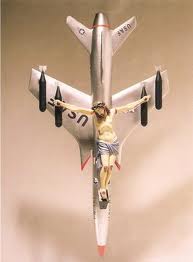
Practitionor: León Ferrari and his supporters
Normal
0
21
false
false
false
ES-TRAD
JA
X-NONE
/* Style Definitions */
table.MsoNormalTable
{mso-style-name:”Tabla normal”;
mso-tstyle-rowband-size:0;
mso-tstyle-colband-size:0;
mso-style-noshow:yes;
mso-style-priority:99;
mso-style-parent:””;
mso-padding-alt:0cm 5.4pt 0cm 5.4pt;
mso-para-margin:0cm;
mso-para-margin-bottom:.0001pt;
mso-pagination:widow-orphan;
font-size:12.0pt;
font-family:Cambria;
mso-ascii-font-family:Cambria;
mso-ascii-theme-font:minor-latin;
mso-hansi-font-family:Cambria;
mso-hansi-theme-font:minor-latin;}
- The León Ferrari Issue (El caso León Ferrari)
- In the
Argentinean cultural sphere Leon Ferarri embodied resistance to repression and
repudiation of violence, intolerance and abuses of power. A vehement advocate
of freedom, Ferrari was a symbol of denouncement since early in his career and
had been involved in one of the most representative works of the Argentinean
democratic transition in 1983: the Nunca
Más (Never Again). Nunca Más was one of the most emblematic
documents of the return of democracy after the military regime in Argentina
(1976-83) and stated a testimony of repudiation of the violence, repression and
abuses the Junta Militar regime
committed during its years in power. - The Ferrari
issue involves the debate that an exhibition of Ferrari´s work caused in the
Argentinean society in 2004. León
Ferarri: Retrospectiva (León Ferrari: a retrospective), which exposed 50 years
of the artist´s work was programmed to open on the last day of November 2004 in
the Centro Cultural Recoleta
(Recoleta Cultural Center), but even before the opening the more conservative
sectors of the Argentinean society started to raise their voices. - The Centro Cultural Recoleta is situated in
one of the most classic and beautiful parts of the city of Buenos Aires in
Argentina. First used as a drawing school, then as an asylum the Recoleta
Cultural Center is now, since the reestablishment of democracy in Argentina,
one of the most representative Argentinean cultural references. - When the
exposition was first announced there were some reactions, but nothing
unexpected given the controversial and provocative nature of Ferrari´s work.
However, the reaction triggered by the exposition was more hostile than any of
the organizers had imagined. The most important representatives of the Catholic
Church in Argentina sent messages to the press, society and governments asking
for the closure of the exposition referring to it as blasphemous and an offense
to catholic values and living. Conservative politicians asked for the same
thing, along with the destitution of those in charge of organizing the exposition
and private investors and sponsors of the exhibition withdrew their support. Radical
conservatives irrupted the exhibition breaking some of the works of art and even
assaulting exposition spectators. - Two days
after the inauguration an ultra conservative catholic group called for a
meeting outside the Church that was closest to the Cultural Center (La Iglesia del Pilar) and on the other
hand, more tan 2000 intellectuals, politicians, human rights advocates and
liberal citizens congregated to defend the artist and freedom of expression. - Protest was
not the only reaction; conservative groups opted for more radical measures and
went to court. The rejection of the exposition culminated with legal charges
pressed by a catholic organization called Asociación
Cristo Sacerdote. The whole argument was based on the exposition violating
religious freedom stipulated in the Argentinean Constitution. The judges in
charge of the case, after evaluating the charges pressed, decided to cancel the
exposition claiming that most of Argentineans were catholic and thus were being
deeply offended by Ferrari’s art. - When the
decision was made public, more than 5,000 freedom of expression advocates
concentrated outside the Cultural Center and painted murals, sang, played
instruments and together repudiated the court decision of closing the
exhibition. - The court´s
decision was appealed and after a few weeks the court revoked the order of
shutting down the exhibition and permission to re open was granted. On the
first days of 2005 the exhibition was re inaugurated and before two months of it’s
reopening it had been visited by more than 70,000 people. - The Ferarri
issue is not only a symbol of civil resistance to censorship but it became a
legal precedent for future liberty of expression cases in Argentina. It also raised an important debate around the
role of the Church in public affairs, the complex relationship between art,
State and private industries and the place Church and art have or should have
in the Argentinean society. The León Ferrari issue has become a central reference
on freedom of expression and tolerance of diversity for Argentinean politics
and citizens.
External sources:
Posted by
on